
Quick Summary
Buying the wrong part wastes money, no matter how low the price. Verify your engine’s make, model, horsepower, year, and serial number, match them to the part number, and confirm the supplier will stand behind fit before you pay. Done right, you get affordable marine engine parts that work the first time.
Few things frustrate a boater more than a part that arrives and doesn’t fit. Shopping for affordable marine engine parts only pays off when the part is correct, because a wrong-fit order costs you shipping, downtime, and often a missed weekend on the water. This guide walks through the exact steps we use at Marine Trading Post to confirm compatibility before a customer spends a dollar.
A part that is cheap but incompatible is the most expensive purchase you can make. Even small differences, such as a different thread pitch or a revised casting, can leave an engine running poorly or not at all. Our counter staff see this every season, which is why we always verify fit first and discuss price second. Our guide to mistakes to avoid when buying boat engine parts covers the most common errors.
Start with the data plate on your engine. Record the following before you search:
Take a clear photo of the plate. It saves guesswork later and lets a parts specialist confirm details quickly.
Part numbers are the most reliable way to confirm fit. Compare the number on your old part against the listing, and ask whether any supersession applies, since manufacturers sometimes replace older numbers with updated ones. Our article on avoiding wrong-fit outboard parts online explains what to double-check on a product page.
Different brands use different designs, so shop by brand when you can. We stock dedicated catalogs for Yamaha boat engine parts, Mercury boat engine parts, Johnson boat engine parts, and Evinrude boat engine parts. Browsing by brand narrows the field and reduces the chance of an incompatible match.
Brand | What to Confirm | Common Pitfall |
Yamaha | Model year and serial range | Mid-year revisions to parts |
Mercury | Horsepower and serial number | Similar-looking parts across models |
Johnson | Original vs. updated part number | Older numbers superseded |
Evinrude | Engine series and year | Series-specific gaskets and seals |
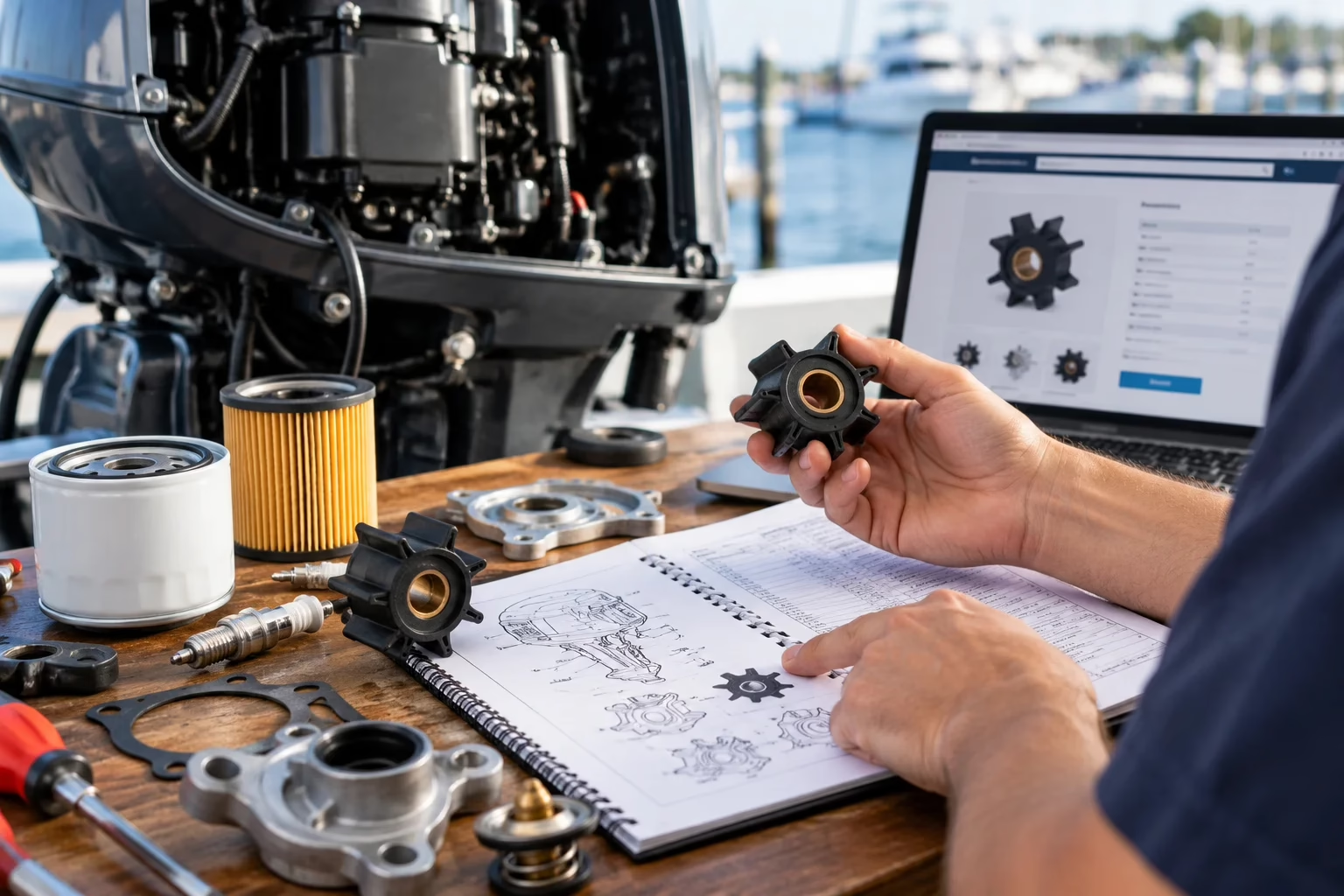
Filters and seals look similar but differ in dimension, micron rating, and material. Confirm measurements, and make sure the material suits marine fuel and saltwater exposure. Our guides on how often to replace marine engine filters and seals and how to spot quality marine engine parts and seals show what to look for.
Expert Insight
In our experience, filters and seals are the parts most often ordered by ‘close enough’ guesswork. A seal that is a fraction too thin can weep within weeks. Always compare dimensions against the old part, and keep it until the new one is installed.
Both can be good value. OEM parts offer guaranteed specifications, while quality aftermarket options can cut costs on routine items. Read our breakdown of genuine vs. OEM marine engine parts and whether aftermarket boat parts are worth buying before choosing.
The best place to buy boat engine parts combines fair pricing with real fit support. Online listings are convenient, but a local marine engine parts dealer can read your data plate, compare the old part by hand, and accept a return without a long shipping cycle. For boaters wanting marine engine parts in Florida, Marine Trading Post operates three locations in Fort Myers, Port Charlotte, and Naples, and has helped Southwest Florida boaters since 1985.
Factor | Online Only | Local Dealer |
Fit confirmation | Listing details only | Hands-on comparison |
Returns | Shipping and delays | Often same-day |
Price | Competitive | Competitive, no shipping |
Expert advice | Limited | Immediate |
Can’t find an exact match? Use our request-a-part form and our team will track it down.
Affordable marine engine parts are only a bargain when they fit. By gathering your engine details, matching part numbers, verifying filters and seals, and buying from a local dealer who stands behind fit, you protect both your budget and your boating time. Marine Trading Post has spent over three generations helping boaters across Fort Myers, Port Charlotte, and Naples find the right part at a fair price. Visit a store or browse our marine engine parts to get started.
Check the data plate for the model and serial number, then compare the number stamped on the old part. A parts specialist can cross-reference both.
Sometimes, but not always. Parts may share a design across ratings, yet differ in size or specification. Always verify before buying.
Quality aftermarket parts can be reliable for routine maintenance. Confirm specifications and warranty before purchasing.
A local dealer that confirms fit, offers fair pricing, and accepts returns is often the best choice, with online options as a backup.
Provide your engine details to a parts specialist, who can check supersessions and alternative sources.
Yes. Dimensions, material, and rating all affect performance, so match them to the original specification.
we are here for you! How can we help?