
Search

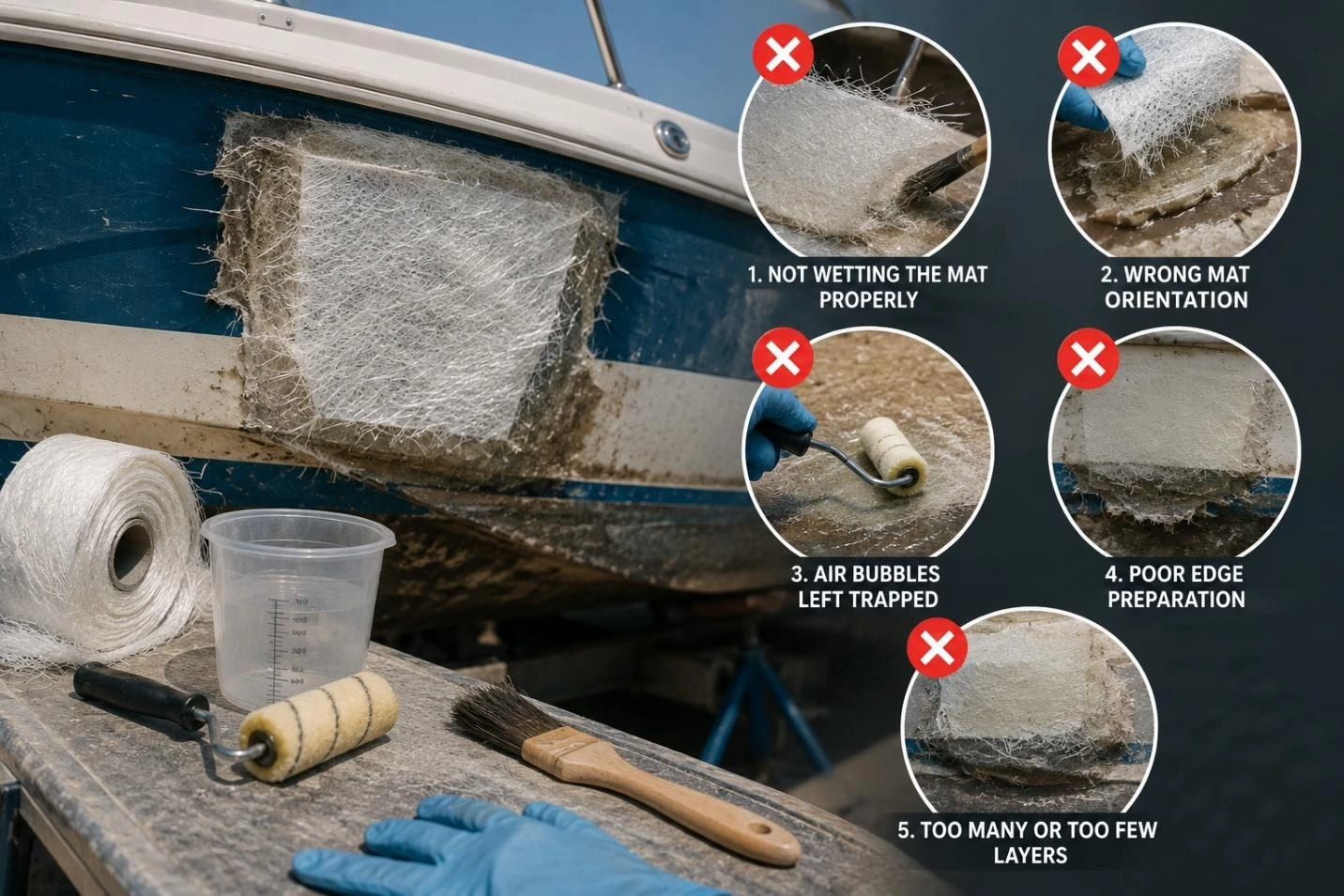
5 Fiberglass Mat Mistakes That Can Ruin a Boat Repair

Fiberglass Repair Supplies

Summary

Fiberglass repairs can restore a damaged boat hull, but small mistakes during the repair process can lead to cracking, delamination, weak spots, and premature failure. This guide covers five common fiberglass mat mistakes, from poor surface preparation and incorrect resin selection to improper catalyst ratios, excessive layering, and trapped air bubbles. Learn how to avoid these problems, choose the right marine-grade materials, and achieve stronger, longer-lasting boat repairs with guidance from Marine Trading Post.

Fiberglass repairs are a fundamental part of boat ownership, and with the right marine fiberglass repair supplies and technique, they can restore a hull to near-original condition. However, even experienced boaters make mistakes when working with fiberglass mat — and some of those mistakes create problems worse than the original damage. At Marine Trading Post, we supply boaters throughout Southwest Florida with professional-grade materials and the guidance to use them correctly.

Understanding Fiberglass Mat Before You Start

Chopped strand mat (CSM) is the most commonly used fiberglass reinforcement for boat hull repairs. Its randomly oriented fibers bond well with polyester resin and conform easily to curved surfaces — making it ideal for marine applications. However, working with fiberglass mat is not as simple as applying it and waiting for it to cure. The quality of your repair depends as much on technique as it does on materials.

Here are the five most common fiberglass supplies mistakes that boaters make, and how to avoid each one.

Mistake 1: Skipping Surface Preparation

The single most common cause of fiberglass repair failure is inadequate surface preparation. Fiberglass mat will not bond properly to a surface that contains moisture, wax, old gelcoat that has not been sanded, or any contamination from oils, chemicals, or mold release agents.

Before laying any mat, the repair area must be:

  • Thoroughly dried — any trapped moisture will cause the repair to delaminate
  • Ground back to clean, bare fiberglass at least 2–3 inches beyond the damage
  • Sanded with 36–80 grit to create a mechanical bonding surface
  • Wiped with acetone to remove dust, oils, and waxy residue

Skipping or rushing this step is the fastest way to end up with a repair that looks fine initially but bubbles, cracks, or separates from the hull within months.

Mistake 2: Using the Wrong Resin for the Mat Type

Not all fiberglass mat and resin combinations are compatible. Chopped strand mat designed for use with polyester resin uses a binder that dissolves in styrene — a component of polyester resin. This dissolution is what allows the mat to conform to surfaces and wet out properly.
If you attempt to use chopped strand mat with epoxy resin, the binder does not dissolve. The mat stays stiff, fails to wet out uniformly, and the resulting laminate has poor structural integrity. Conversely, woven fiberglass cloth and biaxial fabrics are compatible with both polyester and epoxy resins.
When sourcing fiberglass cloth and resin supplies, always confirm compatibility between the reinforcement and the resin system you intend to use. At Marine Trading Post, our staff can help you match the right materials for your specific repair.

Mistake 3: Mixing Resin Incorrectly

Polyester resin requires the addition of a catalyst (MEKP — methyl ethyl ketone peroxide) to initiate the curing process. The ratio of resin to catalyst must be precise. Too little catalyst results in a repair that never fully cures — remaining tacky and soft indefinitely. Too much catalyst causes the resin to cure too quickly, generating excessive heat that can cause cracking, warping, and in severe cases, fire.
The correct ratio is typically 1–2% catalyst by volume, though this varies by temperature and desired working time. In Florida’s warm climate, err toward the lower end of the catalyst range to extend your working time. Always measure by weight or volume — never estimate by eye. Similarly, when working with epoxy resin systems, the ratio of resin to hardener must follow the manufacturer’s specification exactly. Epoxy does not tolerate estimation.

Mistake 4: Applying Too Many Layers at Once

It is tempting to build up a repair in one thick application to save time. In practice, applying too many layers of fiberglass mat at once is one of the most damaging mistakes you can make. Thick laminates generate significantly more heat as the resin cures — a phenomenon called exothermic reaction. Excessive heat causes the repair to crack internally, warp, and in extreme cases, delaminate entirely.
Professional repairs build up in thin layers — typically no more than 3–4 layers at a time — allowing each application to partially cure before the next is added. This approach produces a stronger, more uniform laminate and avoids heat-related damage.
Using fiberglass sheet and mat suppliers who provide consistent, properly manufactured materials also contributes to uniform layup. Inconsistent mat density makes it harder to achieve even saturation and layer thickness.

Mistake 5: Not Removing Air Bubbles During Lamination

Air bubbles trapped between layers of fiberglass mat create voids in the laminate. These voids are weak points where water can infiltrate and where cracks begin. Repairs with significant void content may look sound on the surface while harboring internal damage that becomes apparent months later.

Eliminating air bubbles requires proper technique during lamination:

  • Use a fiberglass roller (stippling roller) to work out bubbles after applying each layer
  • Apply resin from the center of the repair outward to push air toward the edges
  • Do not apply subsequent layers until the previous one is properly wetted out and bubble-free

A quality roller is a small investment that makes a significant difference in repair quality. Marine Trading Post stocks the hand tools and fiberglass supplies near me that boaters in Fort Myers, Port Charlotte, and Naples need to complete professional-quality repairs.

Sourcing Quality Marine Fiberglass Repair Supplies

The quality of your repair is directly tied to the quality of your materials. Marine-grade fiberglass mat, cloth, and resins are formulated to withstand prolonged water exposure, UV radiation, and the structural stresses of a working hull. Consumer-grade or construction-grade alternatives — including some fiberglass insulation supplies or general-purpose resins — may not provide the performance required in a marine environment.
When sourcing materials, look for suppliers with specific marine expertise. Marine Trading Post has served the Southwest Florida boating community since 1985, stocking genuine marine-grade products and providing the technical guidance that makes the difference between a repair that lasts and one that fails.

When to Call a Professional

Some repairs are well within the capability of a skilled DIY boater. Cosmetic gelcoat chips, minor surface cracks, and small through-hull repairs are all manageable with the right marine fiberglass repair supplies and careful technique.
However, structural damage — particularly damage to the stringer system, transom, or hull below the waterline — warrants professional assessment. Structural fiberglass repairs require more complex lamination schedules and engineering knowledge. If you are unsure about the scope of damage, have the repair assessed by a qualified marine technician before proceeding.

Conclusion

Fiberglass repair is one of the most valuable skills a boat owner can develop — but only when it is done correctly. Avoiding the five common mistakes outlined here will dramatically improve the quality and longevity of your repairs: prepare the surface thoroughly, match your mat to the correct resin system, measure catalyst ratios precisely, build up layers gradually, and eliminate air bubbles at every stage. With quality marine fiberglass repair supplies and sound technique, DIY repairs can achieve results that rival professional work. Marine Trading Post is here to supply the materials and expertise that Southwest Florida boaters have relied on for nearly four decades. Contact us today for personalized guidance on your next repair project.

Frequently Asked Questions

Fiberglass mat (chopped strand mat) consists of randomly oriented short fibers held together with a binder and is used primarily for building up thickness and bulk in repairs. Fiberglass cloth has woven fibers oriented in specific directions and provides higher tensile strength. Many repairs use both: mat for bulk and cloth for surface strength.
High humidity can interfere with proper resin cure and increase the risk of moisture being trapped in the laminate. Ideally, work in conditions below 75% relative humidity. If Florida’s climate makes this difficult, work during drier morning hours and avoid working on days with afternoon storms forecast.
Allow the fiberglass laminate to fully cure — typically 24–48 hours at room temperature — before applying gelcoat. Applying gelcoat over partially cured fiberglass can cause adhesion problems and color mismatch as the underlying repair continues to contract during curing.
Marine Trading Post carries a comprehensive selection of marine fiberglass repair supplies at our three locations in Fort Myers, Port Charlotte, and Naples, Florida. Our team can help you select the right mat, cloth, resin, and tools for your specific repair.
Color matching gelcoat is challenging because hull color fades over time from UV exposure. Many boaters achieve acceptable results by mixing tinted gelcoat to approximate the aged color of the surrounding hull. For critical cosmetic repairs on visible areas, a professional detailing or repair shop with spectrophotometer color matching equipment will achieve the best results.
The number of layers depends on the thickness of the original laminate. As a general rule, match the layer count of the surrounding undamaged hull, typically 4–8 layers for a typical recreational boat hull. Your material supplier or a marine technician can advise on the appropriate layup schedule for your specific repair.